UPDATE: You can read a transcript of the chat here:
http://www.realmentalhealth.com/ Hi all,
I will be moderating a chat at realmentalhealth.com on TUESDAY oct 10th at 9pm (EST).
I'll be talking (writing?) about my book and anxiety disorder. Hope you'll stop by and check it out.
Thanks!
Sunday, October 08, 2006

Wednesday, August 23, 2006
Last night Ned Vizzini and I read to a packed house at KGB Bar in NYC. Clearly, I read from I Don't Want to Be Crazy. Ned read from It's Kind of a Funny Story, a semi-autobiographical novel about a teen boy hospitalized for depression.
http://www.nedvizzini.com/
Contrary to how it may sound (anxiety + depression = big downer) it was a really good time. Ned is hilarious. He's also a very talented writer and speaker. There was also a great crowd there--lots of friends, co-workers, and strangers. I like strangers.
A nice surprise was the appearance of Wess "Mongo" Jolley from IndieFeed Podcast Network. He created a podcast of my reading. 16 minutes of me reading from Part I of my memoir. It's all Samantha all the time! You can put me inside your little ipod and take me with you. How super is that?!
As of 8/24 you can get the podcast for FREE using the info below. I'll do my best to add it to my myspace page or something, but I'm not so savvy with these newfangled electronics.
Also, photos of the event to come soon...
To get the podcast:
Subscribe via iTunes:
http://phobos.apple.com/WebObjects/MZStore.woa/wa/viewPodcast?id=120373332&s=143441
Subscribe via an aggregator such as Juice or iPodder (paste this link into your aggregator) : http://feeds.feedburner.com/IndiefeedPerformancePoetry
Or, if you want to just download one show at a time, you can do that through our site:
http://performancepoetry.indiefeed.com/
http://www.nedvizzini.com/
Contrary to how it may sound (anxiety + depression = big downer) it was a really good time. Ned is hilarious. He's also a very talented writer and speaker. There was also a great crowd there--lots of friends, co-workers, and strangers. I like strangers.
A nice surprise was the appearance of Wess "Mongo" Jolley from IndieFeed Podcast Network. He created a podcast of my reading. 16 minutes of me reading from Part I of my memoir. It's all Samantha all the time! You can put me inside your little ipod and take me with you. How super is that?!
As of 8/24 you can get the podcast for FREE using the info below. I'll do my best to add it to my myspace page or something, but I'm not so savvy with these newfangled electronics.
Also, photos of the event to come soon...
To get the podcast:
Subscribe via iTunes:
http://phobos.apple.com/WebObjects/MZStore.woa/wa/viewPodcast?id=120373332&s=143441
Subscribe via an aggregator such as Juice or iPodder (paste this link into your aggregator) : http://feeds.feedburner.com/IndiefeedPerformancePoetry
Or, if you want to just download one show at a time, you can do that through our site:
http://performancepoetry.indiefeed.com/
Friday, August 18, 2006
I have been reluctant to post random happenings in my blog, but today I was struck by something so bizarre that I had to write about it.
Today I had lunch with a co-worker at a Thai restaurant in Soho. It's called Peep. Lovely atmosphere, if a little loud, and the food was delicious and well priced. I hadn't thought of the name much . . . except for making a brief connection to those marshmallow chicks . . . until I went to the bathroom.
The two bathrooms doors were flush with the back wall of the restaurant. A little weird to walk into the bathroom next to a table, but not the end of the world. When I went inside I had some trouble finding the light. I turned around to keep looking, and was BEYOND shocked to find that I had a view of the ENTIRE restaurant! I froze. What that fuck? I thought. I tried to remind myself that the exterior of the wall was mirrored, but it didn't help much. [I kept questioning if they really had been mirrored, or if I just thought they were.] I stood there for a moment, watching people eat and waiters running around. Was I seriously supposed to pee while looking at 50 strangers . . .who were eating?
Needless to say I have never peed so quickly or with so much anxiety in life.
So, that's it.
Happy Friday.
I hope you all get to pee in peace this weekend.
sam
Tuesday, August 15, 2006
I feel like it's my birthday! I just saw these two reviews and couldn't be happier!
"A young author makes a stunning debut with this poetry memoir documenting her personal battle with anxiety disorder and the incapacitating panic attacks that first struck during college. Schutz bares all but is never tedious as she documents the difficulties of finding a good doctor and the right medication while struggling to finish college and set her own course apart from her parents. Anxiety disorders affect an estimated 13 percent of the adult population of the U.S., and Schutz performs a valuable service with this firsthand account of the torment they experience."
--The Buffalo News
"[Schutz's] tale is related in an intimate poetry memoir that is compelling and informative."
--Detroit Free Press
Monday, August 14, 2006
My next reading is going to be super.
I am reading with Ned Vizzini, author of It's Kind of a Funny Story, a semi-autobiographical novel about a teen hospitalized for depression.
You might be thinking, "Anxiety and depression . . . what a downer." But I can promise there's also a healthy dose of humor in there, too.
August 22, 2006
7pm
KGB Bar: 85 East 4th Street
Friday, July 21, 2006
From Scholastic.com
“This week at Scholastic headquarters in New York, Trade publishing editor Samantha Schutz told co–workers about some of her greatest personal struggles. No, this wasn’t an impromptu group therapy session, but a "Library Lunchtime Talk" during which Schutz gave one of the first public readings of I Don’t Want to Be Crazy, a poetry memoir about her struggle with anxiety disorder. Released this month under the Scholastic PUSH imprint, the book is already on The Poetry Foundation’s top ten Children’s Best Sellers list.
Introducing the Scholastic employee and first–time author, Scholastic editorial director and executive editor David Levithan said, “Some people use words to hide themselves, others to find themselves. Samantha has used words to find herself, and is brave enough to share them with others.” And share she did, reading poems that describe—sometimes breath to breath—the panic attacks that intensified during her freshman year in college. Based on journals she kept throughout her college years, the poems vividly convey what the experience of an anxiety attack is like—and describe how Schutz learned to cope, with help from campus health services, a therapist, and a psychiatrist.
Schutz recommends this very personal memoir to readers age 14 and up. She is currently talking with representatives of psychiatric associations, clinics, and other interested groups about how her book can be used as a tool to help the thousands of children and adolescents who have anxiety disorder.
You can read more about I Don’t Want To Be Crazy on scholastic.com, and check out her biography while you’re there. Samantha’s personal website has excerpts from her book, links to info resources on anxiety disorder and other mental health concerns, and news about her upcoming readings and events. You can also find out about the Scholastic PUSH imprint, which is dedicated to new authors and new voices, at thisispush.com.”
“This week at Scholastic headquarters in New York, Trade publishing editor Samantha Schutz told co–workers about some of her greatest personal struggles. No, this wasn’t an impromptu group therapy session, but a "Library Lunchtime Talk" during which Schutz gave one of the first public readings of I Don’t Want to Be Crazy, a poetry memoir about her struggle with anxiety disorder. Released this month under the Scholastic PUSH imprint, the book is already on The Poetry Foundation’s top ten Children’s Best Sellers list.
Introducing the Scholastic employee and first–time author, Scholastic editorial director and executive editor David Levithan said, “Some people use words to hide themselves, others to find themselves. Samantha has used words to find herself, and is brave enough to share them with others.” And share she did, reading poems that describe—sometimes breath to breath—the panic attacks that intensified during her freshman year in college. Based on journals she kept throughout her college years, the poems vividly convey what the experience of an anxiety attack is like—and describe how Schutz learned to cope, with help from campus health services, a therapist, and a psychiatrist.
Schutz recommends this very personal memoir to readers age 14 and up. She is currently talking with representatives of psychiatric associations, clinics, and other interested groups about how her book can be used as a tool to help the thousands of children and adolescents who have anxiety disorder.
You can read more about I Don’t Want To Be Crazy on scholastic.com, and check out her biography while you’re there. Samantha’s personal website has excerpts from her book, links to info resources on anxiety disorder and other mental health concerns, and news about her upcoming readings and events. You can also find out about the Scholastic PUSH imprint, which is dedicated to new authors and new voices, at thisispush.com.”
Friday, July 14, 2006
Thursday, July 13, 2006
This is my "People Have Problems...and So Do You" booklist.
I know I am forgetting some amazing books, but will add more soon. Feel free to add comments of other books I forgot.
Teen Angst? Naaah...: A Quasi-Autobiography
Ned Vizzini
A collection of essays written by the author from age fifteen to seventeen in which he shares impressions of school, sports, cool people, boring people, friends, family, money, music, and obsessions.
It's Kind of a Funny Story
Ned Vizzini
Craig Gilner is a gifted 15-year-old boy who works hard to get into a fiercely competitive high school, then crumbles under the intense academic pressure. Blindsided by his inability to excel and terrified by thoughts of suicide, Craig checks into a psychiatric hospital where he finally gets the help he needs.
Luna
Julie Anne Peters
"This novel sensitively portrays the life of a transgender teen through the eyes of a sympathetic younger sister," wrote PW.
Skin
Adrienne Maria Vrettos
Fourteen-year-old Donnie's older sister, Karen, has always been the one person in his life on whom he could totally depend. But as Karen slowly slips away in the grip of an eating disorder, Donnie finds himself alone in facing the trauma of his parents' faltering marriage and his new life as an outcast at school.
Burn Journals
Brent Runyon
Runyon's first-person account of his close brush with death and his painful rehabilitation is reminiscent of Girl, Interrupted and Running with Scissors.
Talking in the Dark
Billy Merrell
Merrell lays open the journal of his life, taking readers with him through his parents' divorce, his awakening sexuality, and his quest to find love and acceptance while discovering himself in the process.
Perfect
Natasha Friend
Following the death of her father, a thirteen-year-old uses bulimia as a way to avoid her mother's and ten-year-old sister's grief, as well as her own.
Cut
Patricia McCormick
While confined to a mental hospital, thirteen-year-old Callie slowly comes to understand some of the reasons behind her self-mutilation, and gradually starts to get better.
Crank
Ellen Hopkins
This devastating story, told in poetry, is even more frightening because it is based on the author's own experiences with her addicted daughter.
Wild Roses
Deb Caletti
Seventeen-year-old Cassie Morgan has a secret: She's living with a time bomb (a.k.a. her stepfather, Dino Cavalli). To the public, Dino is a world-renowned violinist and composer. To Cassie, he's an erratic, self-centered bully.
Stop Pretending: What Happened when My Big Sister Went Crazy
Sonya Sones
A younger sister has a difficult time adjusting to life after her older sister has a mental breakdown.
Speak
Laurie Halse Anderson
When Melinda Sordino's friends discover she called the police to quiet a party, they ostracize her, turning her into an outcast -- even among kids she barely knows. But even worse than the harsh conformity of high-school cliques is a secret that you have to hide.
Smack
Melvin Burgess
After running away from their troubled homes, two English teenagers move in with a group of squatters in the port city of Bristol and try to find ways to support their growing addiction to heroin.
Damage
Amanda M. Jenkins
Seventeen-year-old football hero Austin, trying to understand the inexplicable depression that has drained his interest in life, thinks that he has found relief in a girl who seems very special.
Shattering Glass
Gail Giles
When Rob, the charismatic leader of the senior class, turns the school nerd into Prince Charming, his actions lead to unexpected violence.
You Remind Me Of You
Eireann Corrigan
Struggling for years with eating disorders, in and out of treatment facilities, Eireann Corrigan is teetering on the brink of no return when her high school boyfriend attempts suicide.
Detour: My Bipolar Road Trip in 4-D
Lizzie Simon
What is it like to be "bipolar"? Lizzie Simon, a 23-year-old afflicted with this form of mental ailment, goes on a road trip in search of others like her and tells all in this frank and surprising memoir.
Kissing Doorknobs
Terry Spencer Hesser, A. J. Allen (Afterword)
Fourteen-year-old Tara describes how her increasingly strange compulsions begin to take over her life and affect her relationships with her family and friends.
Just Checking
Emily Colas
A frank and funny first-person account of living with obsessive-compulsive disorder.
Tuesday, July 11, 2006
panicdisorder.about.com gave me a really nice review. Thanks Cathleen!
"With raw honesty, Samantha Schutz tells of her personal struggles with panic disorder in I Don't Want to Be Crazy. Framing her journey within her years at college, Schutz writes of her experiences in verse. Easily accessible, the poetry engages the reader instantly and captures the intensity of life with panic disorder. While I Don't Want to Be Crazy often is emotionally painful, the underlying message is one of hope."
Pros
Writing style draws the reader in, from the start
Author's honesty about struggles and triumphs keeps the reader connected
The poetry is emotionally engaging, and the reader feels the author's ups and downs with her.
Cons
There really are no cons -- but readers seeking a "cure" may be disappointed
Description
A memoir written in verse, the book captures and relates emotion in ways that prose would not.
The author accurately depicts the intensity of panic, often inducing emotion in the reader.
For the young panic sufferer, Schutz's memoir provides insight and information.
Ultimately, the book is about asking for help. Schutz shows how she does it and why it's OK.
Guide Review
Samantha Schutz did not experience her first panic attack in college, but it was there that her attacks intensified enough to make her take notice. And then they intensified enough to change her way of living and her way of thinking about herself and the world.
I Don't Want to Be Crazy is Schutz's poetic account of her emotional journey from college freshman year to her first jobs after graduation. From the beginning, Schutz wrestles with many of the same hopes and fears every young person faces. Early in her freshman year, however, Schutz begins to experience intense panic attacks and has no idea what is happening until she winds up at her school's counseling center.
To a reader with an anxiety disorder, the most valuable aspect of I Don't Want to Be Crazy is the author's honesty. Schutz is truthful about every last fear she has, even when, in the past, she was sure she would be considered a "freak" should anyone know what was happening inside her. Schutz is truthful about therapy and medication; for her, there was no overnight cure, just as there isn't for many of us. Finally, Schutz is truthful about why she keeps fighting, about why she believes she is worth it.
I Don't Want to Be Crazy adeptly captures the pain and frustration of panic disorder in a way that captivates the reader from start to finish. At the same time, Schutz lets us know that there is hope:
"With raw honesty, Samantha Schutz tells of her personal struggles with panic disorder in I Don't Want to Be Crazy. Framing her journey within her years at college, Schutz writes of her experiences in verse. Easily accessible, the poetry engages the reader instantly and captures the intensity of life with panic disorder. While I Don't Want to Be Crazy often is emotionally painful, the underlying message is one of hope."
Pros
Writing style draws the reader in, from the start
Author's honesty about struggles and triumphs keeps the reader connected
The poetry is emotionally engaging, and the reader feels the author's ups and downs with her.
Cons
There really are no cons -- but readers seeking a "cure" may be disappointed
Description
A memoir written in verse, the book captures and relates emotion in ways that prose would not.
The author accurately depicts the intensity of panic, often inducing emotion in the reader.
For the young panic sufferer, Schutz's memoir provides insight and information.
Ultimately, the book is about asking for help. Schutz shows how she does it and why it's OK.
Guide Review
Samantha Schutz did not experience her first panic attack in college, but it was there that her attacks intensified enough to make her take notice. And then they intensified enough to change her way of living and her way of thinking about herself and the world.
I Don't Want to Be Crazy is Schutz's poetic account of her emotional journey from college freshman year to her first jobs after graduation. From the beginning, Schutz wrestles with many of the same hopes and fears every young person faces. Early in her freshman year, however, Schutz begins to experience intense panic attacks and has no idea what is happening until she winds up at her school's counseling center.
To a reader with an anxiety disorder, the most valuable aspect of I Don't Want to Be Crazy is the author's honesty. Schutz is truthful about every last fear she has, even when, in the past, she was sure she would be considered a "freak" should anyone know what was happening inside her. Schutz is truthful about therapy and medication; for her, there was no overnight cure, just as there isn't for many of us. Finally, Schutz is truthful about why she keeps fighting, about why she believes she is worth it.
I Don't Want to Be Crazy adeptly captures the pain and frustration of panic disorder in a way that captivates the reader from start to finish. At the same time, Schutz lets us know that there is hope:
Friday, June 30, 2006

I had my first reading on Wednesday and it went really well. I thought I was going to be nervous, but I was surprisingly calm. I'm sure it didn't hurt that every time I looked into the audience I saw family members and close friends.
I read a section from Part III, when I am studying abroad in Paris.
I just need to put a little space
between me and the panic.
I need a little bit of calm
so I can get a grip
and hold on to something,
to pull myself up and out.
THANK YOU to everyone who came out to support me.
Tuesday, June 27, 2006
More NYC readings!
Can't come see me on June 28th @ Teabag Poet's Lounge....here's one more chance.
Tuesday July 11th, 7pm--FREE
Bluestockings
172 Allen Street [between Stanton and Rivington]
http://www.bluestockings.com/
Bluestockings is a radical bookstore, fair trade cafe, and activist center in the Lower East Side of Manhattan. Come support them . . . and me.
Can't come see me on June 28th @ Teabag Poet's Lounge....here's one more chance.
Tuesday July 11th, 7pm--FREE
Bluestockings
172 Allen Street [between Stanton and Rivington]
http://www.bluestockings.com/
Bluestockings is a radical bookstore, fair trade cafe, and activist center in the Lower East Side of Manhattan. Come support them . . . and me.
Monday, June 26, 2006
I am already getting fan mail!
I think it is completely amazing that I am already getting fan mail!
I have only written a few fan emails, and there were all after I had a book deal--as if that gave me some sort of credibility...
I think it's really courageous to send an email to a stranger, praising them, without the certainty that you'll get a reply. But I suppose the reply is secondary. . . sharing how the work made you feel is the important part.
"When I read some of your book, I didn't feel alone anymore."
"Your words described some of my own experiences so precisely, it made me look back at those times and appreciate how far I've come, how much stronger I am, and how much I've grown."
"I felt like I was reading my own journal entries from years ago when I struggled with anxiety attacks. Thank you SO MUCH for writing your book. I hope young people who are fighting their own battles with the consuming anxiety and fear will read your book and find comfort. I wish I had read this when I was going through my hell."
I have only written a few fan emails, and there were all after I had a book deal--as if that gave me some sort of credibility...
I think it's really courageous to send an email to a stranger, praising them, without the certainty that you'll get a reply. But I suppose the reply is secondary. . . sharing how the work made you feel is the important part.
"When I read some of your book, I didn't feel alone anymore."
"Your words described some of my own experiences so precisely, it made me look back at those times and appreciate how far I've come, how much stronger I am, and how much I've grown."
"I felt like I was reading my own journal entries from years ago when I struggled with anxiety attacks. Thank you SO MUCH for writing your book. I hope young people who are fighting their own battles with the consuming anxiety and fear will read your book and find comfort. I wish I had read this when I was going through my hell."
Wednesday, June 21, 2006
For many years, having an anxiety disorder shaped nearly every bit of my life...
For the last few years, whenever I tried to talk about my experience with anxiety disorder, I ran into the same problem. I couldn’t describe myself as having an anxiety disorder because I’d gone months without having a panic attack. And I couldn’t say I had an anxiety disorder because I still felt its effects.
Trying to find the right verb was more than just semantics. For many years, having an anxiety disorder shaped nearly every bit of my life—where I went, who I went with, how long I stayed. I do not believe that anxiety disorder can be flipped off like a switch, and accordingly, simply using past or present tense did not accurately reflect how I was feeling. The body has an unbelievable capacity to remember pain, and my body was not ready to forget what I had been through. It was only about a year ago that I settled on saying, “I am in recovery from anxiety disorder.”
I was diagnosed with panic disorder only a few months into my freshman year of college. My first attacks were scattered and seemingly without pattern. But it wasn’t long before the attacks picked up speed and I was having several a day. I often felt nervous, not in control of my body, and convinced that I was going to die. As their frequency increased, it became difficult to do normal things like go to class, the dining hall, or parties.
It was textbook panic disorder. Only I didn’t know that. I thought I had gone crazy and that all the things I hoped for in my life—that my parents hoped for—were gone and that I’d become one of those stories (the one about the nice young girl who goes off to college with a bright future and comes home with a fistful of pills and a blank look on her face).
I am thankful that I possess two qualities: being forthcoming about my feelings and being proactive about my health. I believe that these qualities are a big part of the reason that I was able to ask for help. And getting help was surprisingly easy. One fall afternoon I went to my college’s counseling center and asked for an appointment. Within days I was seeing a therapist and a psychiatrist and was on medication.
That was ten years ago. Since that fall, I have seen more than a half dozen therapists and taken as many different medications. I’ve had two episodes where I nearly checked myself into a hospital. I have been to yoga and meditation classes, swung tennis rackets at pillows, practiced the art of breathing, tried hypnosis, and taken herbal remedies. I’ve done things that once seemed impossible—like going to crowded concerts or sitting with relative ease in a packed lecture hall. I’ve also gone many months at a time without panic attacks or medication. Most recently, I published I Don’t Want to Be Crazy, a memoir about my experiences with panic disorder.
People want to know why I’m better. They want to know the formula. Again, this is not a simple question with a simple answer. For sure, fluctuating hormones, growing older, moving out of my parents’ house, and becoming more confident and secure with myself have all impacted my recovery. The only thing I can say with certainty is that my commitment to therapy and my willingness to try new medications has made the most difference.
Trying to find the right verb was more than just semantics. For many years, having an anxiety disorder shaped nearly every bit of my life—where I went, who I went with, how long I stayed. I do not believe that anxiety disorder can be flipped off like a switch, and accordingly, simply using past or present tense did not accurately reflect how I was feeling. The body has an unbelievable capacity to remember pain, and my body was not ready to forget what I had been through. It was only about a year ago that I settled on saying, “I am in recovery from anxiety disorder.”
I was diagnosed with panic disorder only a few months into my freshman year of college. My first attacks were scattered and seemingly without pattern. But it wasn’t long before the attacks picked up speed and I was having several a day. I often felt nervous, not in control of my body, and convinced that I was going to die. As their frequency increased, it became difficult to do normal things like go to class, the dining hall, or parties.
It was textbook panic disorder. Only I didn’t know that. I thought I had gone crazy and that all the things I hoped for in my life—that my parents hoped for—were gone and that I’d become one of those stories (the one about the nice young girl who goes off to college with a bright future and comes home with a fistful of pills and a blank look on her face).
I am thankful that I possess two qualities: being forthcoming about my feelings and being proactive about my health. I believe that these qualities are a big part of the reason that I was able to ask for help. And getting help was surprisingly easy. One fall afternoon I went to my college’s counseling center and asked for an appointment. Within days I was seeing a therapist and a psychiatrist and was on medication.
That was ten years ago. Since that fall, I have seen more than a half dozen therapists and taken as many different medications. I’ve had two episodes where I nearly checked myself into a hospital. I have been to yoga and meditation classes, swung tennis rackets at pillows, practiced the art of breathing, tried hypnosis, and taken herbal remedies. I’ve done things that once seemed impossible—like going to crowded concerts or sitting with relative ease in a packed lecture hall. I’ve also gone many months at a time without panic attacks or medication. Most recently, I published I Don’t Want to Be Crazy, a memoir about my experiences with panic disorder.
People want to know why I’m better. They want to know the formula. Again, this is not a simple question with a simple answer. For sure, fluctuating hormones, growing older, moving out of my parents’ house, and becoming more confident and secure with myself have all impacted my recovery. The only thing I can say with certainty is that my commitment to therapy and my willingness to try new medications has made the most difference.
Tuesday, June 20, 2006
I Don't Want to Be Crazy readings in NYC
I'll be doing a short reading with several other poets at Silk Road Café/Teabag Poets Lounge.The second one is at KGB with Ned Vizzini, a super author. If you can only make it to one event, this is the one to go to.
Wednesday, June 28th
8:00-10:00 p.m.
Silk Road Café/Teabag Poets Lounge
30 Mott Street
$1 at the door, with $5 drink minimum
www.teabagnyc.com/poetslounge.shtml
Thursday, July 20th7:00-9:00 p.m. [CANCELLED, WILL BE AT END OF AUGUST]
FREE Reading
[also with Ned Vizzini, author of Its Kind of Funny Story www.nedvizzini.com]
KGB Bar
85 East 4th Street
www.kgbbar.com
I'll be doing a short reading with several other poets at Silk Road Café/Teabag Poets Lounge.The second one is at KGB with Ned Vizzini, a super author. If you can only make it to one event, this is the one to go to.
Wednesday, June 28th
8:00-10:00 p.m.
Silk Road Café/Teabag Poets Lounge
30 Mott Street
$1 at the door, with $5 drink minimum
www.teabagnyc.com/poetslounge.shtml
Thursday, July 20th7:00-9:00 p.m. [CANCELLED, WILL BE AT END OF AUGUST]
FREE Reading
[also with Ned Vizzini, author of Its Kind of Funny Story www.nedvizzini.com]
KGB Bar
85 East 4th Street
www.kgbbar.com
Tuesday, June 13, 2006
Monday, June 12, 2006
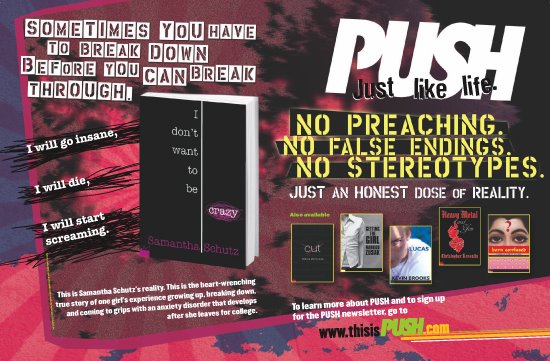
I'm on seventeen.com

My book is on Seventeen magazine's Web site!!!
http://www.seventeen.com/funstuff/games/
Which must-read book should be on your summer reading list? Take this quiz for a list of six exciting books that you won't be able to put down!
My book falls under the DRAMA category:
You thrive on hearing the latest gossip and juicy secrets! That's why we know you'll be into books with a mix of romance and drama all rolled into one!
What they say about my book:
A true story, this book is about coming to grips with a psychological disorder. When Samantha first left home for college, she thought she was leaving behind all the things that were holding her back from independence -- her parents, her boyfriend and the person she was supposed to be. But, as new pressures in her life increase, Samantha begins to suffer from anxiety attacks that leave her shaken and even physically incapacitated. She then heads on a journey down the road to discovery, learning to cope with her new disorder.
Sightings!

There has been a sighting! A writer from Arizona bought my book in Borders.
So, this makes it officially ON SALE!
I'll have to go to my local book store to see it for myself...
Thursday, May 25, 2006
So it happened! I held my book.
So it happened! I held my book.
I was sitting at work when someone dropped two copies on my desk.
For a while, I had wondered how I would react when I finally saw my book. Would I cry? Scream? Be speechless?
It turns out that I did a lot of jumping up and down . . . . and a look-at-how-gorgeous-my-book-is dance [there are no words to describe how silly this was.]
I stared at the book for a long time. I felt the cover, smelled the paper, inspected the binding, appreciated that I didn't look like a freak in my author photo, and oh-ed and ah-ed over the garnet colored endpapers. [Somehow I had forgotten that hardcovers have those.]
Then I ran around the office showing my book to anyone who would talk to me. After I made the rounds, my face was sore from all the smiling.
And then I remembered that thousands of these books are going to be printed and [hopefully] read. Oddly enough, I sometimes forget that--like the process of writing and getting my book published was only for me.
People ask me all the time if that's weird--knowing that strangers will be reading about the worst part of my life. Strangers I can deal with. I don't have to talk to them. I don't have to sit next to them at dinner or in a meeting.
The thing that sometimes freaks me out is that several of my coworkers [and my parents] have read it. Lately, people have been coming up to me at work to tell me congratulations and that they just read my book.
I am always tremendously grateful to hear when someone has read my book. Thrilled if they say they liked it. A little bit sad when they say that they, or someone they know, has an anxiety disorder.
But when the conversation is over, I have to erase it. I can't walk around the office thinking, he knows how I've been on more than a 1/2 dozen different medications or she knows how close I came to hospitalization . . . and then of course, there’s the stuff about guys . . . .
But in reality, I know that what I wrote about isn’t all that different from what other people have gone through. Yeah, the details are different, but the emotions are the same.
Tuesday, May 09, 2006
We all have problems.
We all have problems.
But that's ok. That's life.
What's not ok is NOT GETTING HELP.
Approximately one in five young people suffer from a diagnosable mental disorder in a given year. (Department of Health & Human Services)
An estimated two-thirds of all young people with mental health problems are not getting the help they need. (Department of Health & Human Services)
Approximately one in four adults—more than 57 million people—suffer from a diagnosable mental disorder in a given year. (National Institute of Mental Health)
Anxiety Disorders are the most common mental illness in the U.S. with 19.1 million (13.3%) of the adult U.S. population (ages 18-54) affected.
As many as 1 in 10 young people (10%) may have an anxiety disorder. (U.S. Department of Health & Human Services)
Nearly 50% of all adolescents who are clinically depressed also have an anxiety disorder. (NYU Child Study Center)
20-40% of all adolescents with eating disorders will also have Obsessive Compulsive Disorder. (NYU Child Study Center)
But that's ok. That's life.
What's not ok is NOT GETTING HELP.
Approximately one in five young people suffer from a diagnosable mental disorder in a given year. (Department of Health & Human Services)
An estimated two-thirds of all young people with mental health problems are not getting the help they need. (Department of Health & Human Services)
Approximately one in four adults—more than 57 million people—suffer from a diagnosable mental disorder in a given year. (National Institute of Mental Health)
Anxiety Disorders are the most common mental illness in the U.S. with 19.1 million (13.3%) of the adult U.S. population (ages 18-54) affected.
As many as 1 in 10 young people (10%) may have an anxiety disorder. (U.S. Department of Health & Human Services)
Nearly 50% of all adolescents who are clinically depressed also have an anxiety disorder. (NYU Child Study Center)
20-40% of all adolescents with eating disorders will also have Obsessive Compulsive Disorder. (NYU Child Study Center)
Bio...
Queens, New York, December 1978. I was born too early and too small. Weighing just shy of four pounds, my father said I looked like a chicken. My mother said I looked like a china doll. I’m not sure what my three-year-old sister thought of me, but I’ve heard stories about toddlers trying to put their new siblings in the trash.
Elementary school started out okay. I have a few select memories from kindergarten: a student’s grandfather, an Italian chef, coming to our class to cook squid on a hot plate; building a toy car out of pieces of wood; and putting milk money into a very, very small brown envelope.
The next few years were mostly all right. The highs included: performing as Jackie and the Beanstalk in a third-grade play, reading Choose Your Own Adventure books (and always cheating), and getting up to “knee-zies” in Chinese jump rope. The lows included: hiding in the bathroom whenever math homework was collected in the fifth grade, frequent feelings of déjà vu, and being told I had “skeleton hands” by the boy I had a crush on.
Sixth grade was the beginning of a new era—private school—where the classes were small and my inability to do math was quickly discovered. This is also when I wrote my first short story. It was based on an old photograph of my mother’s—a man and a woman standing in the woods with their backs to the camera.
My teacher gave me an A, something I didn’t often get. My parents went crazy for the story, and my seeming maturity. The consensus was that I had talent.
At some point in high school I started keeping a journal (not to be confused with the pink diaries with heart shaped locks that I had had before). Every few months I’d go to the drug store to buy a new marble composition book. I’d spend a lot of time decorating the cover with stickers, drawings, photos, and cut outs from magazines. And when I thought the cover was sufficiently cool, I’d start writing in it.
When I was a senior in high school, I took AP Writing. Our teacher required us to write ten journal pages a week. I think I was one of the few in the class who didn’t mind. But by then I was already a journal addict. I couldn’t go anywhere without it. And if I left my notebook at home by mistake, I would write on scraps of paper, napkins, my hand, anything. (This was also the year I discovered Anais Nin--the undisputed queen of journal writing.)
There were two things I loved most about having a journal. The first was that it filled my time. Waiting for a train? No problem. Stuck on the bus? All set. Trying to ignore my classmates during my free period? Super.
The second thing I loved was how my journals felt. Not the weight of the book, but the pages. I loved running my hands over my writing, over the impressions made by my pen. It was like my own version of braile.
When I was ready to begin writing I Don’t Want to Be Crazy, my memoir about anxiety disorder, I took out my journals from senior year of high school through the year after I graduated college. I thought that transcribing all the entries about anxiety would be easy--that there would be enough to fill a book. I was so wrong. My journals from freshman year had almost nothing about anxiety--ironic since I thought I was losing my mind.
Things didn’t look so easy anymore. I needed a new plan. Instead, I used my journals to help me recreate my world. They reminded me who I was friends with, what types of parties I went to, and what classes I was in. Other journals were more helpful—especially the ones from when I was studying abroad in Paris my junior year. Those journals were far more explicit about my anxiety. For the first time, I could actually lift entire poems from my journal and use them in my book (with much editing, of course).
One thing that I noticed throughout all my journals was a constant self-awareness of their significance. I would often scold myself as I wrote: “Must write neater. This is going to be important.” I had always fantasized that one day my journals would be published—although, I was fairly certain that I would have to die tragically first.
Thankfully, that didn’t happen. I Don't Want to Be Crazy came out in July 2006, and I'm still here. I live in New York City and work as a children’s book editor at a publishing house. I still write in my journal whenever I can.
Elementary school started out okay. I have a few select memories from kindergarten: a student’s grandfather, an Italian chef, coming to our class to cook squid on a hot plate; building a toy car out of pieces of wood; and putting milk money into a very, very small brown envelope.
The next few years were mostly all right. The highs included: performing as Jackie and the Beanstalk in a third-grade play, reading Choose Your Own Adventure books (and always cheating), and getting up to “knee-zies” in Chinese jump rope. The lows included: hiding in the bathroom whenever math homework was collected in the fifth grade, frequent feelings of déjà vu, and being told I had “skeleton hands” by the boy I had a crush on.
Sixth grade was the beginning of a new era—private school—where the classes were small and my inability to do math was quickly discovered. This is also when I wrote my first short story. It was based on an old photograph of my mother’s—a man and a woman standing in the woods with their backs to the camera.
My teacher gave me an A, something I didn’t often get. My parents went crazy for the story, and my seeming maturity. The consensus was that I had talent.
At some point in high school I started keeping a journal (not to be confused with the pink diaries with heart shaped locks that I had had before). Every few months I’d go to the drug store to buy a new marble composition book. I’d spend a lot of time decorating the cover with stickers, drawings, photos, and cut outs from magazines. And when I thought the cover was sufficiently cool, I’d start writing in it.
When I was a senior in high school, I took AP Writing. Our teacher required us to write ten journal pages a week. I think I was one of the few in the class who didn’t mind. But by then I was already a journal addict. I couldn’t go anywhere without it. And if I left my notebook at home by mistake, I would write on scraps of paper, napkins, my hand, anything. (This was also the year I discovered Anais Nin--the undisputed queen of journal writing.)
There were two things I loved most about having a journal. The first was that it filled my time. Waiting for a train? No problem. Stuck on the bus? All set. Trying to ignore my classmates during my free period? Super.
The second thing I loved was how my journals felt. Not the weight of the book, but the pages. I loved running my hands over my writing, over the impressions made by my pen. It was like my own version of braile.
When I was ready to begin writing I Don’t Want to Be Crazy, my memoir about anxiety disorder, I took out my journals from senior year of high school through the year after I graduated college. I thought that transcribing all the entries about anxiety would be easy--that there would be enough to fill a book. I was so wrong. My journals from freshman year had almost nothing about anxiety--ironic since I thought I was losing my mind.
Things didn’t look so easy anymore. I needed a new plan. Instead, I used my journals to help me recreate my world. They reminded me who I was friends with, what types of parties I went to, and what classes I was in. Other journals were more helpful—especially the ones from when I was studying abroad in Paris my junior year. Those journals were far more explicit about my anxiety. For the first time, I could actually lift entire poems from my journal and use them in my book (with much editing, of course).
One thing that I noticed throughout all my journals was a constant self-awareness of their significance. I would often scold myself as I wrote: “Must write neater. This is going to be important.” I had always fantasized that one day my journals would be published—although, I was fairly certain that I would have to die tragically first.
Thankfully, that didn’t happen. I Don't Want to Be Crazy came out in July 2006, and I'm still here. I live in New York City and work as a children’s book editor at a publishing house. I still write in my journal whenever I can.
Subscribe to:
Posts (Atom)


 Posts
Posts